

The "Invisible" Killer: Why Your EDC17C64 ECU Cage could be a Ticking Time Bomb
In the world of automotive diagnostics, we usually look for software bugs or sensor failures. But sometimes, the biggest threat to a vehicle’s electronics isn't a short circuit—it's physical friction.
The image above shows a 2014 VAG EDC17C64 ECU. At first glance, it looks like standard engine bay wear. But look closer at those scuff marks on the aluminum casing. That is the beginning of a process that ends with a bricked car and a massive repair bill.
What’s Happening?
The EDC17C64 is housed in a metal "cage" or bracket. Because diesel engines (like the TDI units this ECU manages) produce significant vibration, and the chassis moves constantly during driving, the ECU and its cage rub against each other thousands of times per mile.
This creates a micro-abrasion effect. The harder metal of the cage acts like a file, slowly grinding away the softer aluminum shell of the ECU.
The Path to Failure
This isn't just a cosmetic issue. Here is why those rub marks are dangerous:
Casing Thinning: Aluminum is soft. Over tens of thousands of miles, the cage can rub a significant depth into the casing.
The Breach: Eventually, the metal becomes thin enough to develop micro-fractures.
Water Ingress: The EDC17C64 is a sealed unit, but once that metal is compromised, moisture, road salt, and engine grime find a way in.
Internal Corrosion: Once water hits the internal PCB, the ECU is often beyond repair. You'll see "Communication U0100" codes, intermittent stalling, or a total "No Start" condition.
Prevention is Cheaper than Replacement
If you’re a DIYer or a tech working on a 2011-era Volkswagen, Audi, or Skoda, don't just bolt this back in as-is. You have two main options to save the EDC17C64:
Option 1: Create a Buffer Place a simple piece of high-temp rubber, silicone padding, or foam tape between the contact points of the cage and the ECU casing. This absorbs the engine's harmonics and stops the metal-on-metal grinding instantly.
Option 2: Remove the Cage Entirely In many scenarios, the best solution is to simply remove the outer security cage altogether. While originally designed to prevent tampering or theft, in a ten-year-old vehicle, it often serves as nothing more than a "cheese grater" for your ECU casing. Removing it eliminates the friction source permanently and makes future servicing much easier.
The Bottom Line: Don't let a simple metal bracket rub your car's brain to death. A few minutes of prevention today could save you the massive headache of a water-damaged ECU tomorrow.
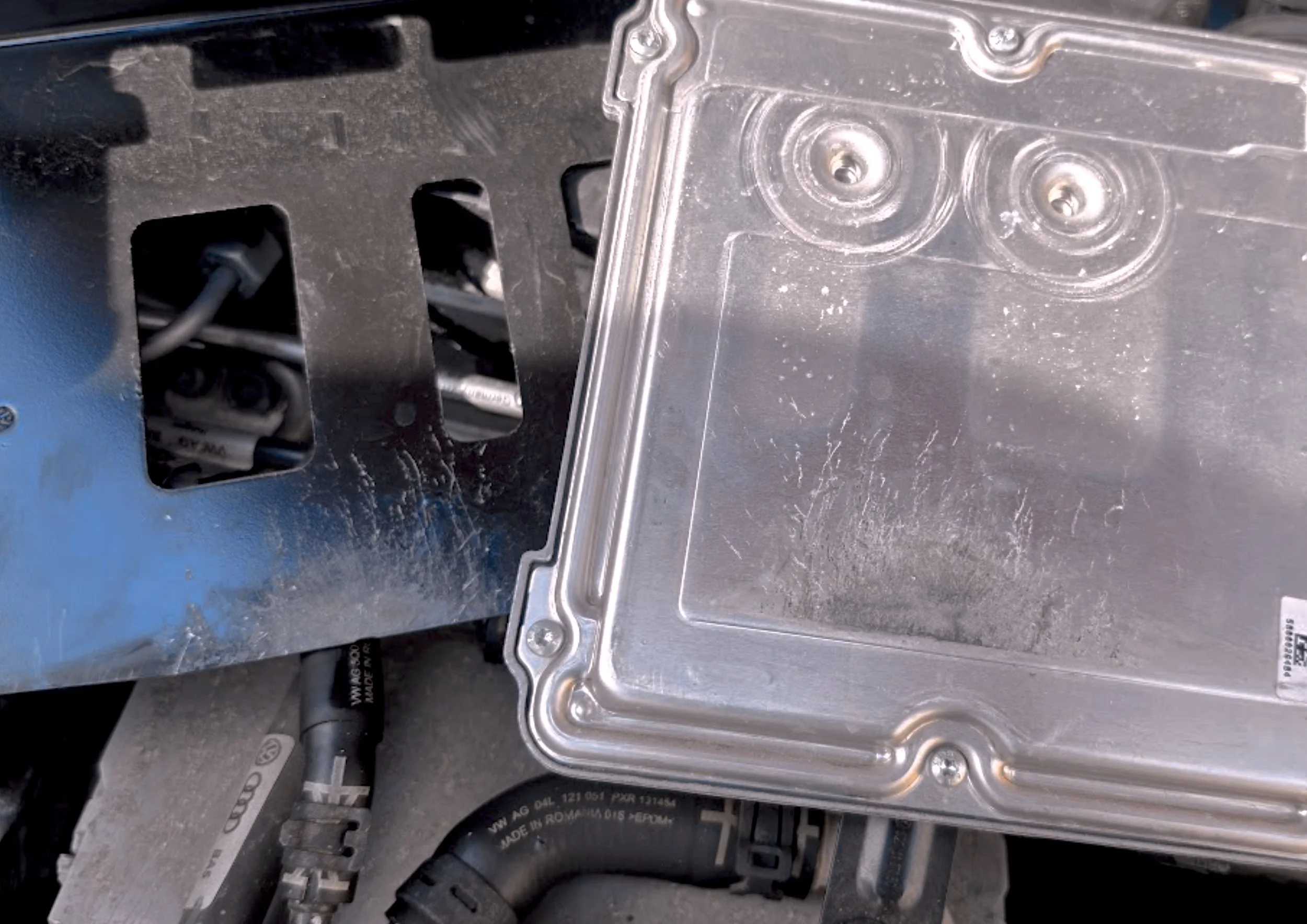
EDC17C64 ECU with the starting of a fracture in the left just off centre, full backup made, should a new ecu be needed in the future for my customer.