

The Phantom Faults
How a Waterlogged Loom and an "Invisible" Crank Sensor Almost Killed a Maserati
Every mobile tech knows the feeling of a "ghost in the machine"—those bizarre, intermittent faults that pop up on the dash, trigger a mini-panic attack, and then vanish into thin air before you can even get out to the vehicle.
I recently headed back out to a regular customer of mine to look at their Maserati, which was dealing with exactly this kind of psychological warfare. The dash was lighting up like a Christmas tree, but the car would seemingly cure itself minutes later.
If you own a modern Italian performance car, you know they don't handle electrical quirks lightly. I set up my mobile diagnostics and dug deep. What I found was a perfect storm of design flaws, severe corrosion, and a sneaky sensor completely hidden from standard diagnostic tools.
Diagnostic Nightmare 1: The Eaten ECU
When I started tracing the wiring loom right out of the van, I found the root cause of the phantom dashboard lights. The Engine Control Unit (ECU) casing was literally being eaten away by corrosion.
Here is how it happened:
The Trap: The ECU was resting directly on top of the main wiring loom.
The Culprit: Over time, water had managed to make its way into that section of the loom, turning it into a literal wet sponge.
The Damage: Because the ECU was sitting on this trapped moisture, galvanic corrosion took over. The aluminum casing was deteriorating, allowing moisture to threaten the delicate circuit boards inside.
Luckily, we caught it just in time. A few more weeks of exposure and the ECU would have been completely bricked—a mistake that would have cost the customer thousands to replace and program. I was able to clean, treat, and save the unit right there on-site before irreversible damage occurred.
The Italian Curveball: Just when we thought we had the ghost cornered, the customer uncovered a notorious design quirk unique to this specific model.
Diagnostic Nightmare 2: The "Invisible" Crank Sensor
With the ECU safely secured and the wiring dried out, we still had a lingering issue: the car wasn't starting reliably. Normally, a faulty crank position sensor is easy to spot because it throws a hard fault code during a diagnostic scan.
Not on this Maserati.
As it turns out, the crank sensor on this specific model is not connected to the diagnostic wiring line. It is a well-known issue within the specialist community, but a massive headache if you don't know ahead of time. Because the sensor operates completely outside the onboard diagnostic (OBD) communication loop:
The car can suffer from bad crank signals, causing intermittent stalling or a no-start condition.
The ECU won't log a fault code for it.
A standard scanner will tell you everything is perfectly fine.
Essentially, the sensor goes blind to the computer, leaving you to diagnose it the old-fashioned way.
The Verdict
It was a wild diagnosis, but this Maserati is officially out of the danger zone. The ECU has been rescued from a watery grave, the loom is sorted, and those phantom faults are gone for good. Once the new crank position sensor is dialed in and sorted, this beauty will be back up and running perfectly.
If your high-end ride starts throwing mysterious, self-curing tantrums, don't ignore them. Water moves in mysterious ways, and electronics don't swim well!
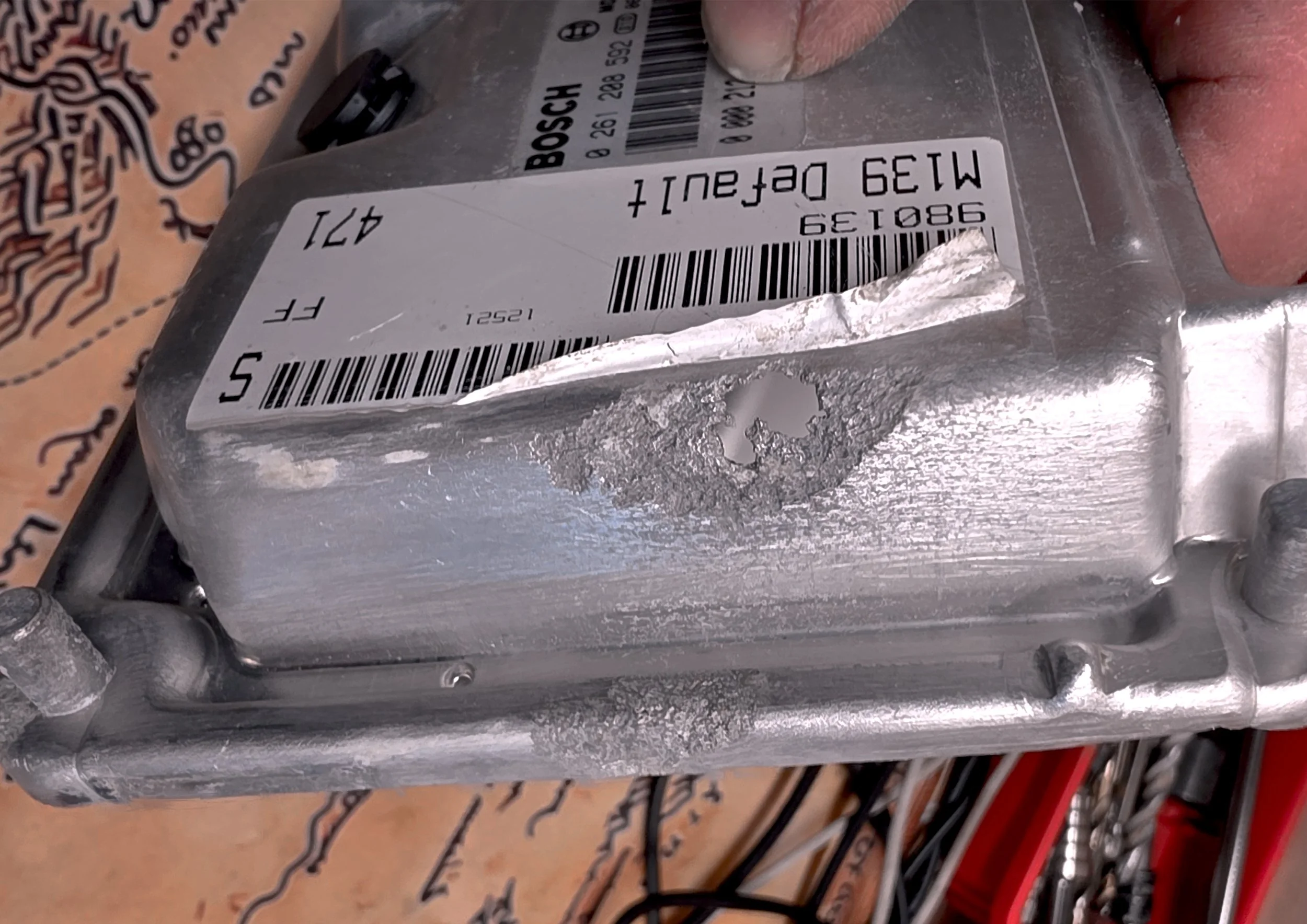
Cleaned off ME7.1.1, eaten away by corrosion